Categorias
Novo blog
Reconhecimento de som por IA Tonmind SIP-M01: dispare alarmes VMS automaticamente com detecção de áudio inteligente
September 02 , 2026O Tonmind SIP-M01 Microfone de Segurança IP adiciona deteção de áudio inteligente aos sistemas CCTV e VMS existentes. Com a sua tecnologia de reconhecimento de som por IA integrada, o SIP-M01 pode identificar automaticamente sons anormais predefinidos e acionar eventos de alarme num Sistema de Gestão de Vídeo (VMS), ajudando o pessoal de segurança a responder mais rapidamente a potenciais incidentes.
Isto cria uma solução de segurança mais proativa ao combinar monitorização de áudio, análise de som por IA, vigilância por vídeo CCTV e gestão de alarmes VMS num sistema integrado.
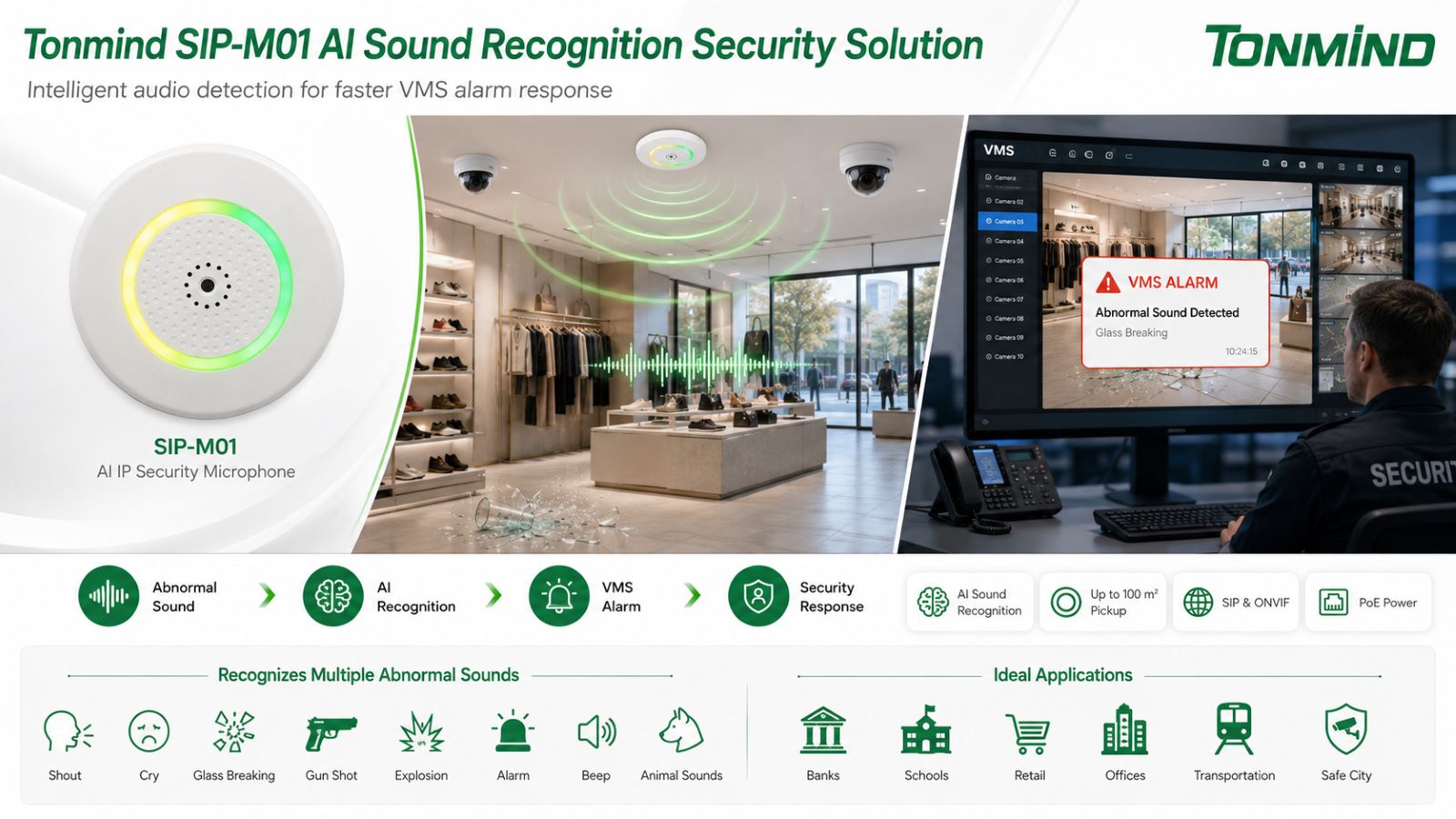
O Tonmind SIP-M01 é um microfone de segurança IP PoE profissional concebido para monitorização de áudio de segurança em interiores.
Utiliza um microfone condensador omnidirecional de alta sensibilidade e pode cobrir uma área de captação de áudio de até 100 metros quadrados. O Controlo Automático de Ganho (AGC) integrado ajuda a equilibrar os níveis de som de diferentes distâncias, proporcionando uma monitorização de áudio mais clara e consistente.
O SIP-M01 suporta os protocolos padrão SIP e ONVIF, permitindo que funcione com sistemas de comunicação IP, bem como com plataformas NVR e VMS compatíveis com ONVIF.
As principais características incluem:
A combinação de áudio de rede, protocolos abertos, análise de IA e interfaces flexíveis torna o SIP-M01 particularmente adequado para projetos modernos de segurança e vigilância.
Uma das funções mais importantes do SIP-M01 é o seu motor de reconhecimento de áudio por IA integrado.
Em vez de simplesmente transmitir som para o centro de monitorização, o microfone pode analisar continuamente o ambiente de áudio circundante e identificar padrões de som anormais específicos.
O SIP-M01 pode reconhecer vários tipos de sons, incluindo:
Quando um dos sons selecionados é detectado, o SIP-M01 pode gerar uma ação de alarme predefinida.
Por exemplo, se o microfone detectar quebra de vidro dentro de uma loja após o horário comercial, ele pode gerar imediatamente um evento que é transmitido para a plataforma de segurança conectada. O VMS pode então notificar o operador de segurança e ajudá-lo a verificar rapidamente a câmera de vigilância correspondente.
Isso muda o monitoramento de segurança de uma escuta passiva paradetecção de áudio automática baseada em eventos.
Como demonstrado no vídeo, o fluxo de trabalho básico é:
Som anormal → Reconhecimento por IA do SIP-M01 → Alarme/Evento → VMS → Operador de segurança
Quando ocorre um som anormal, o SIP-M01 analisa o áudio localmente. Se o som detectado corresponder a uma das categorias de som de IA habilitadas, o microfone gera um evento de alarme.
Como o SIP-M01 suporta integração ONVIF padrão, o dispositivo pode trabalhar em conjunto com plataformas VMS/NVR compatíveis. O VMS pode receber o evento ou sinal de entrada correspondente e executar uma ação definida pelo administrador.
Dependendo da configuração do VMS, as possíveis ações podem incluir:
Os dispositivos Tonmind demonstraram anteriormente a vinculação de eventos ONVIF com plataformas VMS, onde um sinal de entrada pode ser configurado como a fonte do evento e ações do VMS, como notificações na área de trabalho, podem então ser atribuídas a esse evento.
Isso significa que a equipe de segurança não precisa ouvir continuamente cada microfone. O sistema traz automaticamente eventos de áudio importantes para a atenção deles.
Os nomes exatos dos menus podem variar dependendo da versão do firmware do SIP-M01 e do VMS utilizado, mas o processo de configuração geralmente segue estas etapas.
Conecte o SIP-M01 a um switch de rede PoE.
O PoE fornece comunicação de rede e energia através de um único cabo Ethernet, simplificando a instalação e reduzindo o cabeamento adicional.
Certifique-se de que o SIP-M01 e o computador de gerenciamento ou servidor VMS possam se comunicar pela mesma rede.
Encontre o endereço IP atribuído ao SIP-M01 e insira-o em um navegador da web.
Faça login na Interface de Gerenciamento Web do dispositivo.
A partir da interface web, os usuários podem configurar parâmetros de rede, configurações de áudio, funções de alarme, detecção de som por IA e outras opções do dispositivo.
Abra a seção de detecção de som por IA ou configuração de alarme.
Selecione os tipos de som que precisam ser monitorados, como:
Grito / Choro / Quebra de vidro / Disparo de arma / Explosão / Alarme / Bip
Os usuários podem configurar a sensibilidade de detecção necessária de acordo com o ambiente real.
Por exemplo, um escritório pode precisar principalmente de detecção de gritos e quebra de vidro, enquanto um banco, instalação pública ou local de alta segurança pode habilitar categorias de som adicionais.
A Tonmind também suporta várias respostas de alarme locais e de rede, incluindo indicação por LED, chamada SIP, disparo de URL HTTP, disparo de saída, notificação por e-mail, aviso sonoro (bip) e outras ações configuradas.
Adicione o SIP-M01 ao VMS/NVR compatível através de ONVIF.
Uma vez conectado, o VMS pode usar o microfone como parte do sistema de monitoramento de segurança e combinar suas informações de áudio com câmeras de CFTV próximas.
A integração ONVIF permite que os operadores de segurança gerenciem informações de áudio e vídeo a partir do mesmo ambiente de monitoramento, em vez de operar sistemas completamente separados.
Na configuração de eventos ou regras do VMS, selecione o evento/entrada do SIP-M01 como a fonte de disparo.
Em seguida, defina o que o VMS deve fazer quando o alarme for recebido.
Por exemplo:
Quando o SIP-M01 detectar um som anormal → Exibir notificação no VMS → Abrir câmera de CFTV associada.
Diferentes plataformas de VMS oferecem diferentes ações disponíveis, portanto, o fluxo de trabalho de alarme final pode ser personalizado de acordo com os requisitos do projeto.
Após concluir a configuração, gere um som de teste correspondente a uma das categorias de IA habilitadas.
Quando o SIP-M01 reconhecer o som, verifique se:
As configurações de sensibilidade podem então ser ajustadas de acordo com o ambiente acústico real para atingir o desempenho de detecção desejado.
Os bancos exigem consciência de vídeo e áudio em torno de balcões, entradas, áreas de atendimento ao cliente e salas seguras.
O SIP-M01 pode detectar sons como gritos, quebra de vidro, alarmes ou outros eventos anormais e notificar imediatamente o sistema de monitoramento.
Isso permite que os operadores verifiquem o vídeo de CFTV correspondente e respondam mais rapidamente.
Em salas de aula, corredores, prédios administrativos ou outras áreas internas, a análise de áudio por IA pode ajudar a detectar gritos, choro, sons de alarme ou outros eventos acústicos incomuns.
Quando detectado, o sistema pode notificar a equipe de segurança da escola através do VMS.
A detecção de quebra de vidro é especialmente útil para lojas, supermercados, joalherias e instalações comerciais.
Se a quebra de vidro for detectada durante horários sem vigilância, o microfone pode acionar automaticamente um evento de segurança para que o operador possa inspecionar imediatamente as câmeras de CFTV próximas.
Em edifícios de escritórios, o SIP-M01 pode fornecer monitoramento de áudio contínuo em entradas, áreas de recepção, corredores, áreas de reunião e outros locais selecionados.
O reconhecimento por IA de gritos, alarmes ou quebra de vidro pode ajudar as equipes de segurança a identificar situações anormais sem monitorar manualmente cada canal de áudio.
Estações ferroviárias, estações de metrô, aeroportos, saguões de espera e terminais normalmente operam grandes sistemas de CFTV.
Adicionar microfones IP inteligentes permite que eventos de áudio se tornem outra fonte de informações de segurança.
O VMS pode combinar o evento de alarme do SIP-M01 com vídeo de vigilância para melhorar a consciência situacional.
Para implantações de segurança maiores, o monitoramento de áudio inteligente pode complementar a análise de vídeo existente.
A detecção de tiros, explosões, alarmes, gritos e outros sons pode fornecer informações adicionais que as câmeras, por si só, podem não capturar imediatamente.
A Tonmind identifica locais de segurança pública, instalações financeiras, áreas de transporte, escolas, locais industriais e implementações de Cidades Seguras entre as aplicações típicas para o monitoramento de áudio inteligente SIP-M01.
Os sistemas de CFTV tradicionais dependem principalmente de informações visuais.
No entanto, muitos incidentes de segurança também produzem sons distintos.
Uma câmera pode não mostrar imediatamente a quebra de vidro fora do seu campo de visão, enquanto um microfone de segurança pode detectar o som instantaneamente. Da mesma forma, gritos ou um alarme podem indicar um evento anormal mesmo antes que o operador o identifique visualmente.
Ao integrar o SIP-M01 com um VMS, os usuários podem combinar:
Vigilância por vídeo + Detecção de áudio inteligente + Eventos de alarme automáticos
Isso ajuda a reduzir o monitoramento manual contínuo e permite que os operadores concentrem sua atenção em eventos que exigem investigação.
O Microfone de segurança IP Tonmind SIP-M01 transforma o monitoramento de áudio de segurança convencional em um sistema inteligente de detecção de eventos.
Com reconhecimento de som por IA integrado, o SIP-M01 pode identificar sons anormais, como gritos, choro, quebra de vidro, tiros, explosões, alarmes e bipes. Por meio da integração padrão ONVIF, esses eventos detectados podem ser vinculados a plataformas VMS/NVR compatíveis para gerar automaticamente alarmes de segurança e ações relacionadas.
Combinado com captação de áudio omnidirecional de alta sensibilidade, implementação PoE, compatibilidade SIP, vinculação de alarme flexível e integração VMS, o SIP-M01 fornece uma solução eficaz para bancos, escolas, escritórios, lojas de varejo, instalações de transporte, projetos de segurança pública e outras aplicações de vigilância inteligente.
Em vez de depender apenas do que uma câmera pode ver, as equipes de segurança agora também podem responder de forma inteligente ao que o sistema pode ouvir.